Call Us Toll Free - US & Canada : +1-(888) 602-0119

How to Fix WooCommerce Product Variations Not Working (2026 Guide)

A store with WooCommerce product variations not working loses sales quietly, and the cause is nearly always one of five things. Four are setup mistakes. One is a script conflict. They look identical from the shop page, which is why people fix the wrong one. This 2026 guide starts with a two-minute check. It tells you which fault you have. Then it gives you the exact steps for that fault, and what to try when the obvious fix does nothing.

Run This Two-Minute Check First

Open the product page as a customer would. Use a private browser window. What you see there tells you the cause.

No dropdowns at all. The page shows one plain price and a normal Add to cart button. Your product is not set as a Variable product, or the attribute is not marked for variations.

Dropdowns appear but stay empty. The select boxes are there. They contain nothing to choose. Your attribute has no terms assigned to this product.

Dropdowns work, but no price or button appears. You pick a size and colour. Nothing loads underneath. Your variations have no price set.

You get an error message. Note the exact wording. Two different messages point at two different faults, covered in their own sections below.

Nothing responds at all. The dropdowns are dead. Selecting a value changes nothing on screen. This is a broken script, not a setup problem.

Pick the line that matches. Then read only that section. Skipping this step is how a ten-minute fix turns into a whole morning.

Why WooCommerce Product Variations Are Not Working After Setup

Variations need four separate things to be true. Miss any one and the front end goes quiet. Most stores miss the same one.

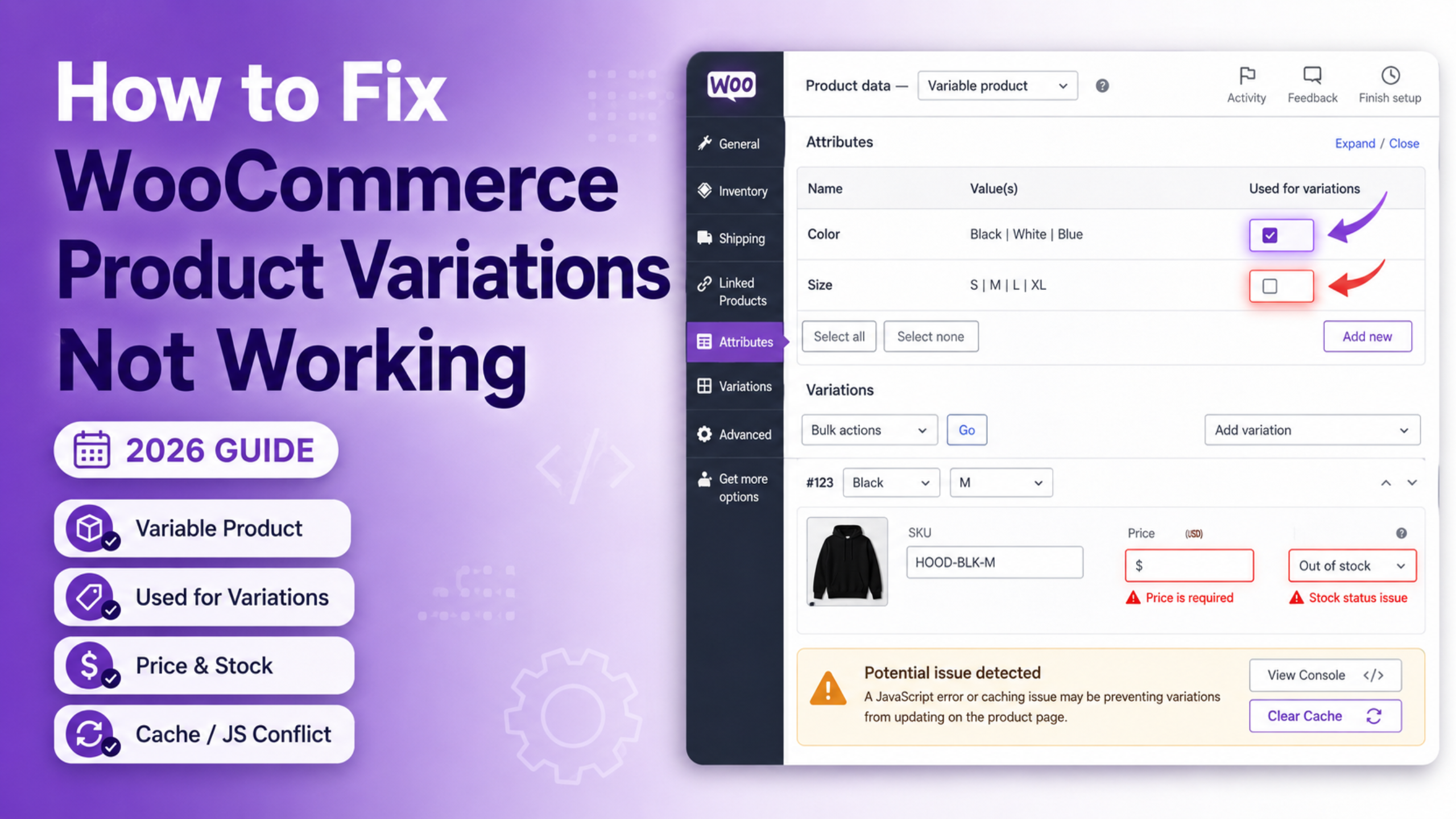
Open the product and look at the Product data dropdown. It must read Variable product. Simple product is the default, and it cannot hold variations at all. Change it and the tabs on the left change with it.

Next, open the Attributes tab. Add your attribute, then add its values. Now find the checkbox labelled Used for variations. Tick it. Click Save attributes and wait for the panel to reload. This checkbox is the single most missed step in WooCommerce. Without it the attribute is treated as plain product information. It shows in the description table and does nothing else.

Then open the Variations tab. Attributes alone create nothing. You must generate the combinations. Use Generate variations to build them all, or add them one at a time.

Finally, give every variation a price. This is the fourth condition and the quietest one. A variation without a price is treated as unavailable. It will not appear, and it throws no warning.

Free items trip people up here. Leaving the price box empty does not mean free. Type a zero instead. Then the variation is valid and customers can add it to the cart.

Fix Variations That Never Appear on the Product Page

You saved everything and the dropdowns are still missing. Work through these three checks in order.

Check that the attribute terms are on this product

Global attributes behave differently from custom ones. A global attribute lives at Products > Attributes and holds its own list of terms. Adding the attribute to a product does not add its terms. You have to select them in the Attributes tab, on that product. An attribute with no terms selected renders an empty dropdown or none at all.

Custom attributes work the other way. Their values are typed into the product itself, separated by a vertical bar. They are quick to set up but cannot be filtered or reused. Convert them to global attributes if you plan to grow the catalogue.

Check the variation stock status

Open the Variations tab and expand each row. Look at Stock status. A variation set to Out of stock still shows in the dropdown. It just cannot be bought. If every variation is out of stock, the whole product reads as unavailable. Managed stock is stricter. A variation with a quantity of zero and backorders off behaves the same way.

There is a setting worth knowing here. Under WooCommerce > Settings > Products > Inventory you can hide out of stock items from the catalogue. Turn that on and sold-out variations vanish from the dropdowns rather than showing as unavailable.

Check the product is actually visible

If the product itself is hidden, nothing on it will render. Look at Catalog visibility in the Publish box. Also confirm the product is Published, not draft or private. A scheduled product behaves like a draft until its date arrives, and it gives no warning on the front end. Our guide on how to hide products in WooCommerce explains what each visibility option really does. If whole sections of your catalogue are missing, read our fix for the WooCommerce shop page not showing products instead.

Fix “No Products Matched Your Selection”

The full message reads “Sorry, no products matched your selection. Please choose a different combination.” It means the customer picked a set of options that has no matching variation.

Sometimes that is correct. You may genuinely not stock a red item in extra large. More often it is a gap you did not intend.

Go to the Variations tab and count. Two attributes with four values each need sixteen variations for full coverage. If you built ten, six combinations are dead. Every dead combination shows this message.

There are two ways to close the gaps. Regenerate all combinations, then delete the ones you do not sell. Or use the Any option. Setting an attribute to Any on a variation makes it match every value of that attribute. One variation with Any Colour and size Large covers every colour in Large. This keeps large catalogues manageable.

Watch for a subtler cause. If you edit or rename attributes after building variations, the links break. The variation still exists but points at a value that is gone. Rebuild the variations after any attribute change. This is the most common reason a working product suddenly stops working.

Fix “Please Select Some Product Options”

This message appears on Add to cart. The full text is “Please select some product options before adding this product to your cart.” WooCommerce is saying it did not receive a full selection.

The honest cause is the common one. Your product has two attributes and the customer only chose one. Both must be set. Nothing to fix there.

The frustrating cause is different. The customer did choose everything, and the message still appears. That means the form value did not reach the server. Check the attribute slug first. Go to Products > Attributes and look at the slug column. Accented letters, ampersands, slashes and spaces in a slug can break the form field name. Rename the slug to plain lowercase letters and hyphens. Then rebuild the variations, because the old ones point at the old slug.

Long attribute names cause the same failure. WordPress limits taxonomy names to 32 characters. An attribute name that runs past that limit gets truncated behind the scenes. The form then submits a value the product does not recognise. Keep attribute names short and this never happens.

What Changes Above Thirty Variations

Variation behaviour changes once a product passes a threshold. By default that number is thirty. This surprises store owners who add a size and suddenly find the page acting differently.

Below the threshold, WooCommerce loads every variation into the page. The dropdowns are smart. Choose Red and the sizes you do not stock in red grey out immediately. Customers cannot pick a dead combination.

Above the threshold, that data is too heavy to send. WooCommerce switches to loading each variation on demand instead. The dropdowns now show every value all the time. Nothing greys out. The customer only learns a combination is unavailable after selecting all of it, and then they see the no-match message.

Nothing is broken here. It is a deliberate trade for page speed. If your product has forty variations and you want the smart dropdowns back, a developer can raise the threshold with the woocommerce_ajax_variation_threshold filter. Raise it carefully. Every extra variation adds weight to the page, and slow product pages cost more sales than clumsy dropdowns do. Products with hundreds of variations are usually better split into several simpler products.

Rule Out Cache, Theme and Script Conflicts

If the dropdowns are completely dead, your setup is probably fine. A script is failing before it can run.

Start with the browser console. Right-click the product page, choose Inspect, then open the Console tab. Reload the page. A red error naming a missing file or an undefined function tells you where to look. The variation form depends on a WooCommerce script called add-to-cart-variation. If that file fails to load, every dropdown goes inert.

The usual culprit is optimisation. Combining or minifying JavaScript can reorder files and break dependencies. Deferring scripts can run the variation form before its libraries exist. Turn off JavaScript optimisation for product pages and test again. If that fixes it, add the variation script to your optimiser’s exclusion list.

Caching plugins cause a slower version of the same problem. A page cached before you added variations keeps serving the old markup. Clear every layer. That means the plugin cache, any server cache, and any network cache in front of the site. Then test in a private window.

If the console is clean, do a conflict test. Switch to a default WordPress theme. If variations work, your theme overrides the variation template. If they still fail, disable other plugins one by one. Filter, swatch and speed plugins are the usual suspects. For pages that will not render at all, see our guide on not being able to view WooCommerce product pages.

Get Expert Help With Your WooCommerce Store

Broken variations are expensive in a quiet way. The product page still loads. Nothing looks obviously wrong. Customers simply cannot buy, and most of them leave without telling you. A single unpriced variation can hide a whole product line for weeks.

The good news is that the causes are few and they repeat. An untouched Used for variations checkbox. A variation with no price. A renamed attribute that orphaned its combinations. A minifier that broke one script. Run the two-minute check at the top of this guide and you will land on the right one straight away.

It is also worth tidying the product pages while you are in there. Clear option labels and a good summary reduce the questions that reach your inbox. Our guide on how to add a short product description in WooCommerce covers that part.

If your variations still refuse to behave, we can take a look. Our team fixes WooCommerce stores every day. We check the product setup, the attribute data, your theme templates and your script stack. Then we tell you plainly what is wrong and what it takes to fix it. Visit WP Customify for expert WooCommerce support today.
How to Fix WooCommerce Cart Not Working (2026 Guide)

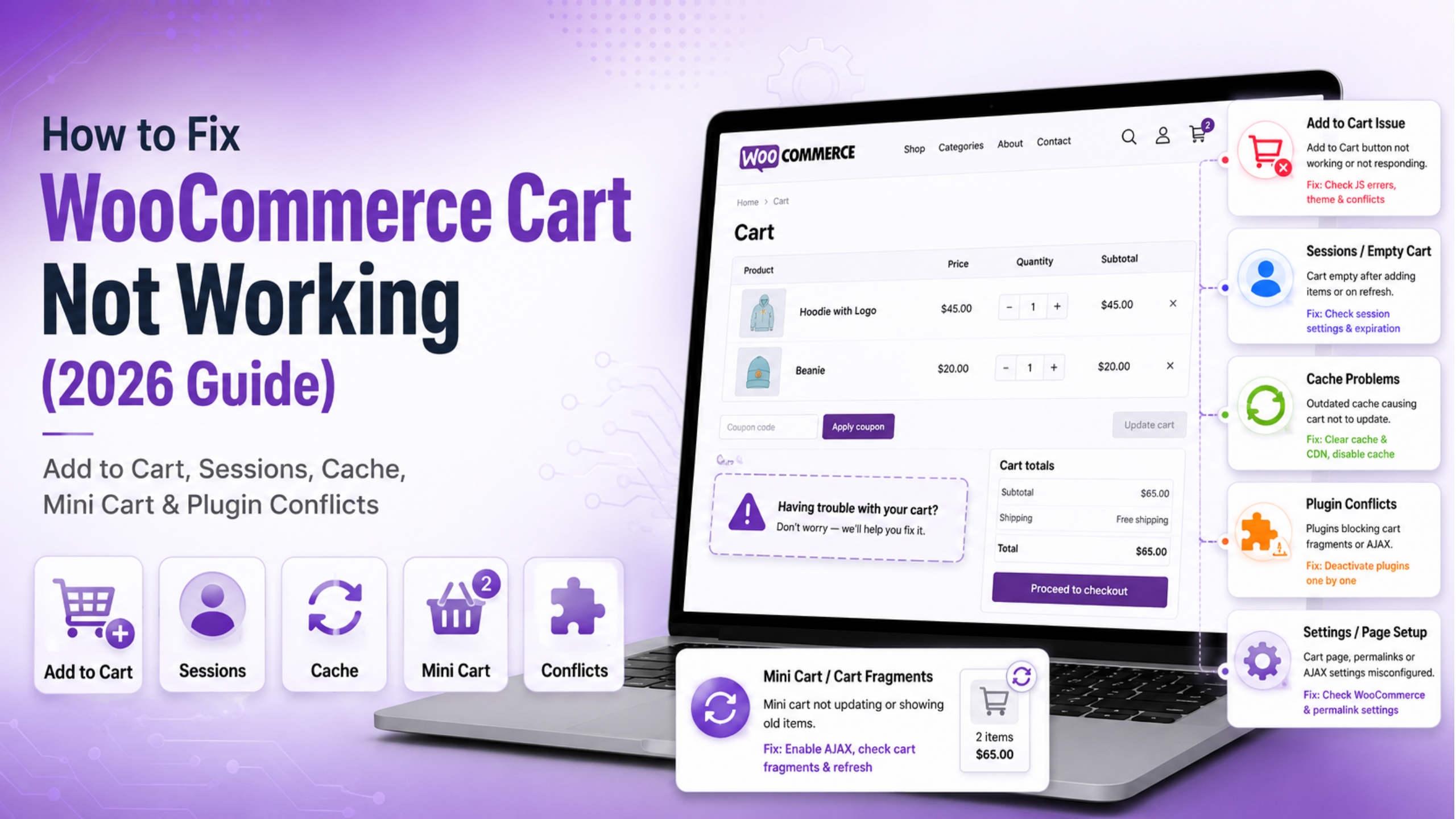
WooCommerce cart not working covers five different faults, and the fix depends entirely on which one you have. Items may refuse to add. The cart may empty itself between pages. Quantities may not update. The cart page may load blank. Or the mini cart may show a stale number while the real cart is fine. Naming your symptom first saves hours, because a fix for one of these cannot touch the others.

Which Cart Symptom Do You Actually Have?

Run this test before changing anything. Log out and open the store in a private window. Then add one simple product to the cart and watch carefully.

Nothing happens on click. The button spins forever, or does nothing at all. Your problem is the add to cart request. Skip to the button section.

The item adds, then disappears. The counter goes to 1, but the cart page says “Your cart is currently empty”. This is a session or caching fault, not a product fault.

The cart page loads blank. No table, no totals, no empty-cart message either. That is a page setup problem, and it is the fastest of the five to fix.

Quantities will not change. You type 3, click update, and it stays at 1. The cart works; the update request does not.

Only the header number is wrong. The cart page is correct but the mini cart disagrees. That is a caching problem confined to one fragment of the page.

Write down which one you saw. Then test a second product. If a simple product works and a variable one does not, the fault is in the product configuration rather than the store.

WooCommerce Cart Not Working Because the Page Is Missing

Handle this first, because it is quick and it explains a blank cart page completely.

Go to WooCommerce > Settings > Advanced. Look at the Cart page dropdown. It must name a published page. If it is empty, or points at a page in the trash, shoppers get nothing. Set it and click Save changes.

Now open that page in the editor. It needs either the Cart block or the [woocommerce_cart] shortcode. A page with neither renders as an empty white area, which looks like a serious bug but is not.

Watch for duplicates. Sites often end up with two cart pages after a redesign, and WooCommerce only honours the one named in settings. Shoppers who reach the other page see an empty cart no matter what they added. Check Pages > All Pages and search for “cart”.

Check the checkout page in the same screen while you are there. A broken cart and a broken checkout usually arrive together, since both are page assignments in the same place. Our guide to checkout process issues in WooCommerce covers the checkout half in detail.

Fix Add to Cart Buttons That Do Nothing

Now the page exists but the button will not work. Read what the button does before you touch settings.

If you see “Please choose product options before adding this product to your cart.”, the product is variable and no variation is selected. Check that every attribute is set to Used for variations, and that each combination has a price. A variation without a price cannot be purchased, and the button silently refuses.

If you see “Sorry, this product cannot be purchased.”, the product itself is the problem. It has no price, or its status is not Published, or its stock status is out of stock.

If you see “You cannot add another item to your cart.”, the product has Sold individually ticked under Product data > Inventory.

If there is no message at all, open your browser console and reload. The button uses an AJAX request on shop and category pages. A JavaScript error from any script on the page stops it firing. The error often comes from something unrelated, which is why this one is hard to trace.

One setting worth knowing: WooCommerce > Settings > Products controls whether AJAX add to cart is enabled on archives. Turning it off makes the button reload the page instead. That is a useful diagnostic, because a button that works without AJAX confirms a JavaScript fault.

Fix a Cart That Empties Itself

Items add correctly, then vanish. The cart is stored against a session, and the session is being lost.

Page caching is the usual cause. Cart, checkout and my account pages must never be served from cache. Most caching layers exclude them by default, but a renamed cart URL slips past those default rules. Confirm the exclusions match the actual page slugs your store uses.

Cookies are the second cause. WooCommerce sets a cookie to link the visitor to their session. Say your site answers on both www and non-www. A cookie set on one address is invisible on the other, so the cart looks empty. Check Settings > General in WordPress. The site address and home address must match exactly. Then force one canonical version of the URL.

Object caching is the third. WooCommerce keeps sessions in the database. An aggressive object cache, or a cleanup job that trims those rows early, drops carts at random. The tell is that it affects some shoppers and not others.

There is a useful reset at WooCommerce > Status > Tools. The Clear customer sessions tool wipes stored sessions. Use it on staging first, since it logs shoppers out and empties every live cart.

Fix Quantities and Totals That Will Not Update

The cart holds its items but refuses to change them. This is a form submission problem rather than a session problem.

Check that the update button is actually enabled. On the classic cart, the Update cart button stays greyed out until you change a quantity field. Shoppers who type a number and press Enter often miss it entirely.

Then check the quantity limits on the product. Under Product data > Inventory, a stock quantity of 2 caps the field at 2. Typing 5 silently reverts to 2, which reads as “the cart will not update” to a customer. If you see “Sorry, we do not have enough items in stock”, that is exactly what happened.

Security plugins and firewalls are the other frequent cause. The cart update posts to a WooCommerce endpoint, and rules that block unusual requests sometimes block it too. The symptom is a page that reloads with no change and no error. Check your firewall log at the moment you clicked update.

Nonce expiry produces the same silence. A cart page left open for hours carries a stale security token, so the update is rejected. Reload the page and try again before assuming anything is broken.

Fix a Mini Cart Showing the Wrong Number

Here the cart page is right and the header is wrong. Only the fragment is stale.

WooCommerce refreshes the mini cart with a separate background request called cart fragments. It runs after the page loads and rewrites the counter. When that request fails or is blocked, the header keeps whatever number the cached page contained.

Test it directly. Add an item, then hard refresh the page. If the number corrects itself on refresh, fragments are not running. If it stays wrong even after a refresh, the whole page is cached and you are back to the caching section above.

Two things commonly block fragments. Some performance plugins disable them deliberately, because the request runs on every page and costs speed. That trade is reasonable on a brochure site and harmful on a shop. Check your optimisation settings for anything naming cart fragments.

A content delivery network can also cache the response. The fragments request must always be dynamic. If your network caches it, every visitor receives the first shopper’s cart count, which is both wrong and a privacy problem worth fixing quickly.

If the counter is slow rather than wrong, that is a performance question instead. Our post on slow checkout loading times covers the same request path.

Rule Out Plugin and Theme Conflicts Safely

Save this for last. The checks above solve most cart faults, and this one carries real risk.

Work on a staging copy. Deactivating plugins on a shop that is taking orders will cost you money, and cart bugs are hard to reproduce once you have disrupted live sessions.

Deactivate everything except WooCommerce, then test the cart. If it works, reactivate in batches rather than one at a time. Halving the list finds the culprit in a few rounds instead of twenty. Then switch to a default WordPress theme and repeat.

Pay closest attention to anything that changes prices, quantities or the cart display. Discount engines, currency switchers and quantity field plugins all hook the same cart calculations. Two of them adjusting the same total will produce results that look random.

Custom code in your theme deserves the same scrutiny. Snippets pasted into a theme file years ago are a common cause, and they survive plugin testing entirely because they are not plugins.

If a discount is involved in the failure, check the coupon rules separately. Our guide to WooCommerce coupons not working at checkout walks through those rejections.

Confirm the Fix as a Real Shopper

Do not trust a cart that works in your admin session. Prove it the way a customer would meet it.

Log out and use a private window. Admin accounts skip some stock and visibility rules, so a cart can behave for you and fail for everyone else. This is the single most common reason a fix gets called done too early.

Clear every cache layer first. Then add a simple product, refresh the page, and confirm the item is still there. Refreshing is the important part, because that is where a lost session shows itself.

Now change the quantity and click update. Watch the line total and the cart total both move. Then add a second product and check the mini cart number in the header matches the cart page.

Test a variable product too. Pick a variation, add it, and confirm the correct option is listed in the cart. Variable products fail in ways simple ones never do.

Finally, walk through to checkout and place a test order. A cart that survives to a completed order is fixed. One that only survives to the cart page is not.

Get Your Cart Working Again

A broken cart is the most expensive fault a store can have. Every other problem still lets someone buy. This one stops the sale at the exact moment a shopper decided to spend money, and almost nobody emails to tell you about it. They simply leave.

That is also what makes it hard to catch. Carts often fail for guests but not for logged in admins, or on one browser but not another, or only when a cache is warm. If you cannot reproduce it yourself, you are not looking at a settings problem you can click your way out of.

WP Customify works on WooCommerce stores every day. We repair add to cart buttons that do nothing, stop carts emptying between pages, fix stale mini carts, and sort out the caching and session rules underneath them. You get a cart that holds what your customer put in it. Visit WP Customify and tell us what your shoppers are seeing. We will find the cause and fix it properly.